The breath of water

Waterfall steps at Lärjedalen
Water cascading down a flight of waterfall steps. Segment of Storåsfallet, Lärjedalen, outside Gothenburg, Sweden.
Photo: Lasse Johansson

Breathtaking, the falling water rumbles down in front of me. At one place a metre or less, at another place cascading from so high above that I cannot estimate it. Moving with all its forms, and yet remaining firmly at the same place. Peaceful in all its turmoil.

What is it that makes it so majestic? Is it the murmuring splashing sound? Is it the slow motion movement, being pulled irresistibly towards the rim, and then falling, falling, falling, until the white foaming surface at the bottom comes to meet? Continue reading “The breath of water”

The power of water

Clouds glowing at night
Water in the sky (clouds) reflecting the power from the sun that feeds us all. Sunset at Fredensborg, Sweden. Photo: Lasse Johansson

“It is junk science”, their adversaries would say. And with a decision ruled beforehand, there was really no need to examine all the intricacies in detail. The electrochemists Martin Fleischmann (1927-2012) and Stanley Pons (1943-) had, in a long series of experiments, observed heat production from electrolysis of heavy water with a special electrode made of palladium. The energy released far exceeded the electrical energy that was put into the experiment. Having examined possible sources of the energy, they had come to the conclusion that a nuclear reaction was going on, and the effect was dubbed “cold fusion” – an effect promising clean and unlimited energy from water. Continue reading “The power of water”

The artist’s water

The undulating water mirror
Reflections in an undulating water surface, stretching in the vertical direction. Slussen, Orust island, at the west coast of Sweden.
Photos and illustrations: Lasse Johansson

Like a painting, the water surface shimmers. Its low undulating forms, just slightly curved, one in front of another, has been shaped by the wind or a passing boat, and the water surface comes to life. Like the memory filtering an artist’s impression, the water surface has its own way of filtering our impressions, the image of the land reflected across the bay appears fuzzy and smeared out. Continue reading “The artist’s water”

The healing water

Glittering water bottles
Water, a most mundane substance (or is it not?), here captured in bottles and glittering in the sun.
Photo: Lasse Johansson

The water flashes in the bottle, refracting the light from the sun. Veiled behind drops of condensation, a small pocket of air resides, between the surface of the water and the cap. Silvery, with a magical shimmer, water can sometimes look almost otherworldly. Like the healing elixir, brought to the companions of King Arthur, from the misty realms of Avalon.

The idea of some waters having a healing power can be traced back at least to ancient Greece. Equally old is the idea that hands-on healing (laying on of hands) may have a healing effect. In the 1960s, the Canadian biologist Bernard Grad (1920-2010) decided to investigate Continue reading “The healing water”

The fish and the propeller

Karman vortex street - fully developed
Kármán vortex street, generated by a paddle and captured on paper with dye. The inrolling motion, clockwise at left, counter-clockwise at right, has developed more fully, and the alternating vortexes are clearly discernible. Paddle movement is downwards. From a workshop with Nigel Wells. Archives of Institute of Ecological Technology.

Flip, flap, flip, flap, the tail fin of the trout swishes to and fro, thrusting the fish forward in the still water. Silently it speeds away under the surface. Seemingly without effort it moves, leaving a series of wakes behind. As a contrast, our propeller thrusts water backwards indiscriminately, creating a white foam of turbulent water behind the boat. How can the fish swim so fast and elegant, almost effortlessly? Continue reading “The fish and the propeller”

The natural flowform

Natural flowforms in the river Sjoa
Natural flowforms in a small side stream beside the main current of river Sjoa. Over time, water has carved the rounded forms, aided by the occasional boulder. Here they express a rhythm of their own, with water dancing from pond to pond. Sjoa, Norway. Photo: Dag Birkeland

Powerful, the mass of water is rushing past me, a white blueish foaming torrent. Confined between the towering stone walls in the gorge, the river here has acquired a relentless quality, thrusting forward unstoppable.

Making sure that I stand on firm ground, I observe it. Falling into the deep river here, one would be lost, immediately being taken into the depths by the strong fraying currents. Here a man’s power matters little. Continue reading “The natural flowform”

Water and climate

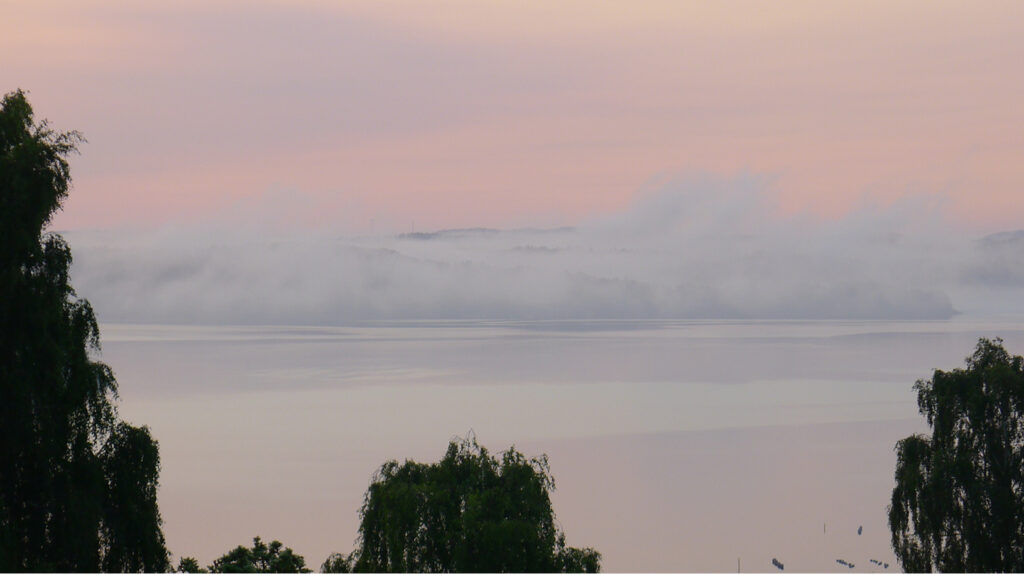
Clouds drifting off the coast at dawn
Clouds drifting off the coast at dawn. View from Orust island, at the west coast of Sweden. Photo: Lasse Johansson

Surrounded by mist, the tree covered ridges sleep across the water. Almost completely wrapped in clouds, the coast is waiting for the day to come. Slowly, slowly, the sun rises in the north-east, tinting the low-hanging clouds pink. Pale and yellow, gazing through the haze, it rises, starting to heat up the air, its heat being almost indiscernible.

Continue reading “Water and climate”

When water freezes

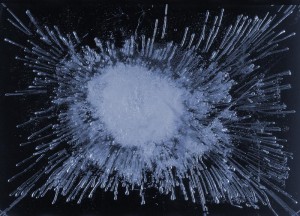
Distilled water ice image
Ice image of distilled water: A sparse and ordered structure surrounds the core. Photo: From the Gisela Ahlberg collection, Institute of Ecological Technology. (The photos have been slightly colorized.)

The temperature drops, water cools, and suddenly, there is a crest of ice on the surface, slowly growing and deepening. Soon it will be so hard that we can touch it without destroying it, and even walk on it. Anyone who has been skating on a lake will know that there is ice and there is ice. Sometimes clear, sometimes so filled with air bubbles as to be almost completely opaque.

The Swedish water investigator Gisela Ahlberg decided to explore this, and devised a method, together with her colleague Christina Weldero, to study natural waters by ice images. Continue reading “When water freezes”

Flow shaping with water plants

Stream water-crowfoot
Egg-shaped patch of Stream Water-crowfoot Ranunculus penicillatus in the Biała Lądecka stream, a submountainous river in Sudety Mountains, distr. Kłodzko, Poland. Photo: Wojciech Puchalski.

The Austrian forester and natural philosopher Viktor Schauberger (1885-1958) perceived many ways of altering a river’s flow, not by trying to steer water into a particular course, but by creating conditions for water to self-organize into a new flow pattern.

By altering the conditions, the river’s flow would effortlessly change into a new pattern. The flow would have a new structurally stable attractor, ever changing yet recognizable as the same. Continue reading “Flow shaping with water plants”

The quality of water

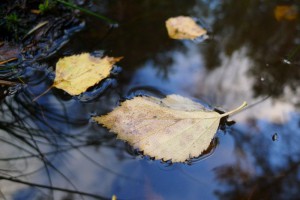
Leaves resting on amber-coloured pond
Birch tree leaves resting on the surface of a small amber-coloured pond that has formed after the rain. Photo: Lasse Johansson

In the autumn, leaves fall onto the ground, into the small ponds forming here and there, soon with brownish amber-coloured water. Resting for a moment on the surface, until a splash or a footstep causes it to cross the surface and sink towards the bottom, contributing to the forming colour.

As the leaves break down, the oxygen in the water is consumed, and the humus acids tint the pond. The water in the lower layers becomes reductive, oxygen deficit. Slowly the water sinks down, and enters the groundwater cycle.

What could these two things, the resting leaf and the amber-coloured water tell us about water quality? Continue reading “The quality of water”

Water’s pulse

“Malmö” model flowforms in Warmonderhof
“Malmö” model flowforms in Warmonderhof, the Netherlands. Photo: Hans van Sluis

Swish, swoosh, swish, swoosh, in a rhythmic pattern, the water swings to and fro in the vessel, a “flowform”, originally conceived by the British anthroposophist John Wilkes (1930-2011) in 1970 and since then developed into many shapes.

The incoming water flow, and the curved heart-shaped walls create the right conditions for a rhythmic flow to spontaneously emerge, to self-organize – a cooperative behaviour, which springs out naturally, effortlessly, from the conditions. The water molecules dance together. From vessel to vessel the dance continues, until the water reaches the pond below. Standing by the stair of flowforms, listening to the pulsating sound, it is as if it radiates tranquillity – a wild brook carved in stone. Continue reading “Water’s pulse”

The rising seas

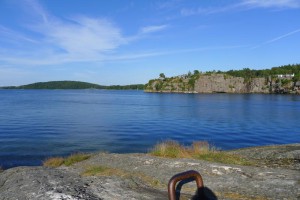
The dramatic coastline of Slussen
The dramatic coastline of the isles seems to rise just out of the sea. Slussen, Orust island, at the west coast of Sweden. Photo: Lasse Johansson

Slowly, almost imperceptibly, the water level rises. Where are we actually heading? What is the attractor of our present course? Where will we be, when water finds its new level?

Our actions are like a small marble, rolling down a slope, along a ridge, on its way to a new state. Will it be a state where the Arctic ice has melted, where its albedo, its ability to reflect light, has changed from that of white ice to dark water, no longer reflecting most of the light back into the sky? Will it be a state where the methane deposits of the Siberian tundra have molten and evaporated? Where the ice of Greenland has melted? Continue reading “The rising seas”