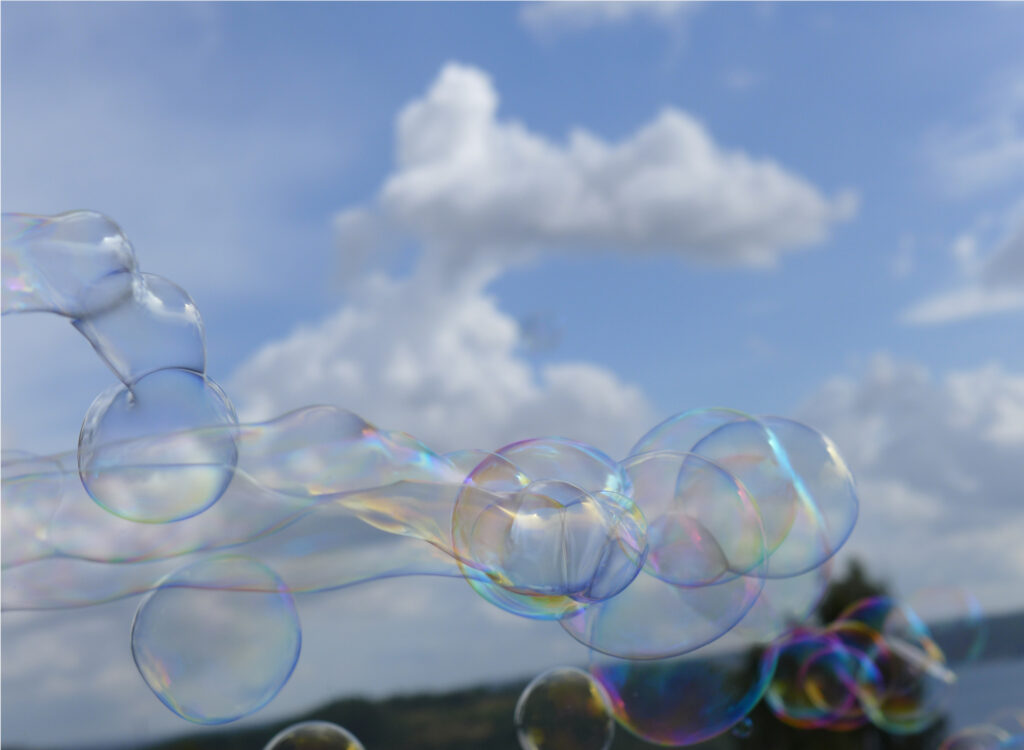
Soap bubbles ejected from a propeller-driven soap wand. The long sausages pinch off into bubbles in the wind. Photos: Lasse Johansson
Tinted in purple and blue, the bubbles float away through the air, upwards for a while, then sinking until they meet the ground or the foliage, disintegrating. Bubble after bubble flows out of the bubble wand, which is forming long sausages by the flow of air, soon pinching off into bubbles.
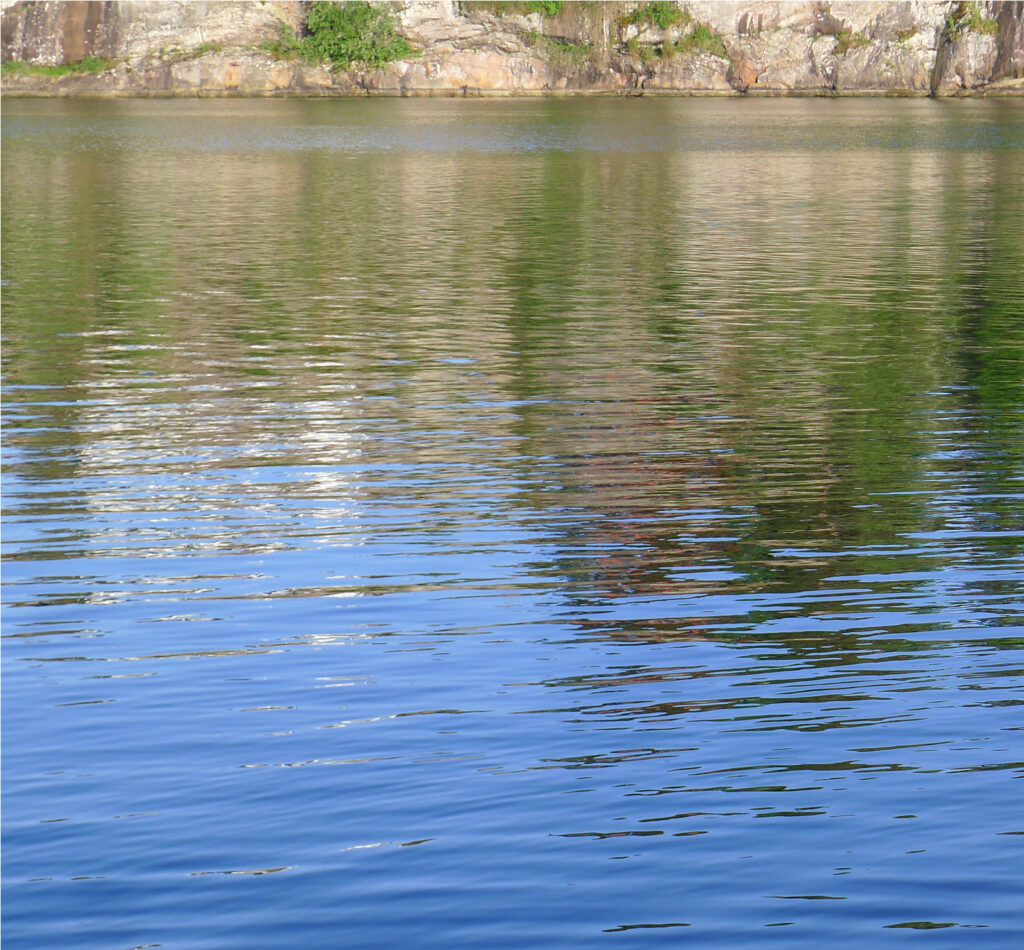
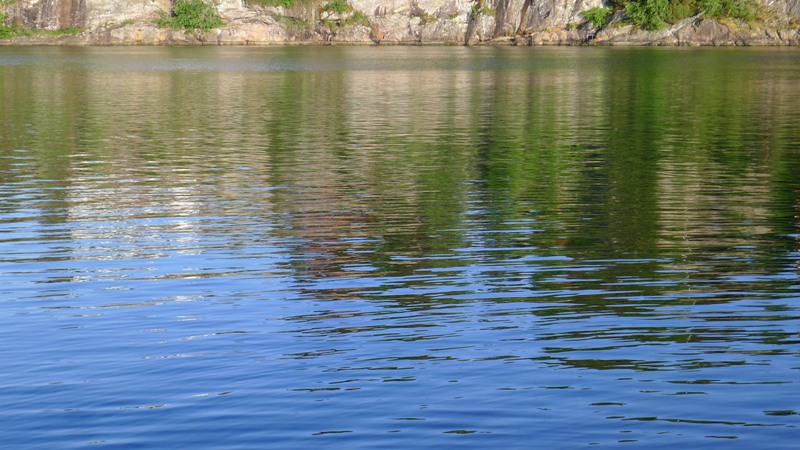
Reflections in water. Orust island, Sweden. Photo: Lasse Johansson
Like a painting, the water surface shimmers. A patchy green stretches down from above, creating a striped impression on the ever moving canvas. The sienna coloured rock walls blend in between. Like the memory filtering an artist’s impression, the water surface has its own way of doing the same.
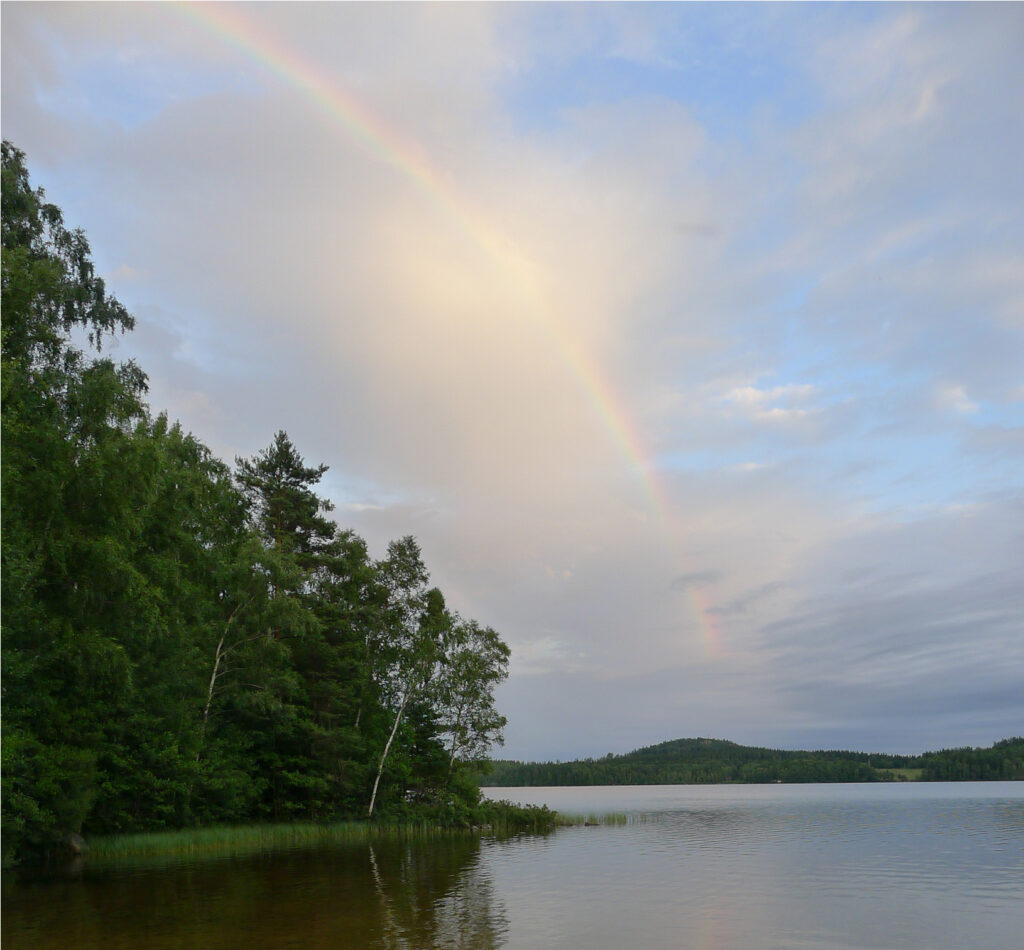
Rainbow reflecting in lake. Fredensborg, Sweden. Photo: Lasse Johansson
A soft light illuminates the sky. In its way: cotton-like clouds and a falling rain. Little drops in the sky, friends to those on the grass, distract the light, turning its path in my direction, exposing its hidden colours. Down below: a mirror completing the path, faintly perceptible, yet there.
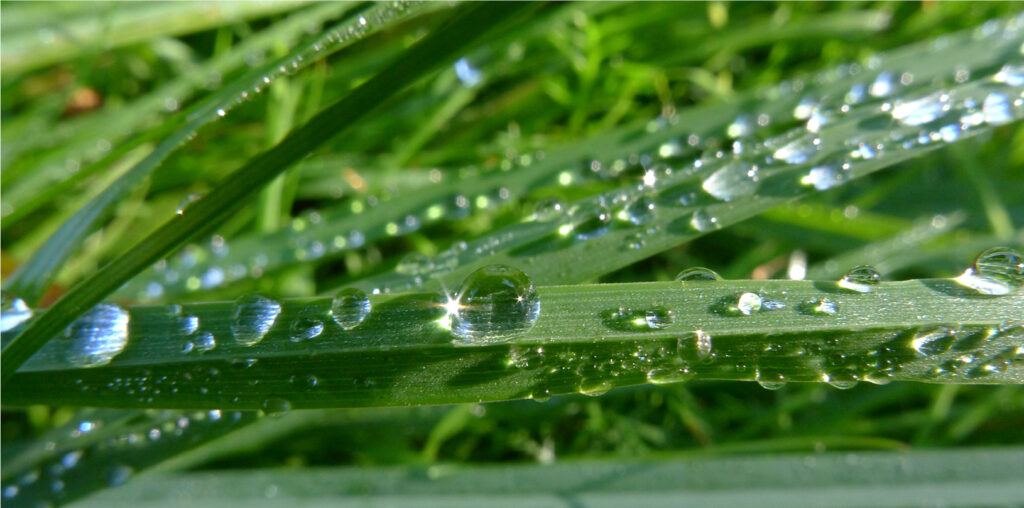
Glistening like diamonds in the morning sun, the small dew drops cling to the grass blades.
The slow wind gently caresses the nearest grass blade. To and fro the tip rocks, irregularly. Settles, for a moment still – and then a gust gives it a puff again. The little dew drops cling to the blade, firmly secured to it by the mutual attraction.
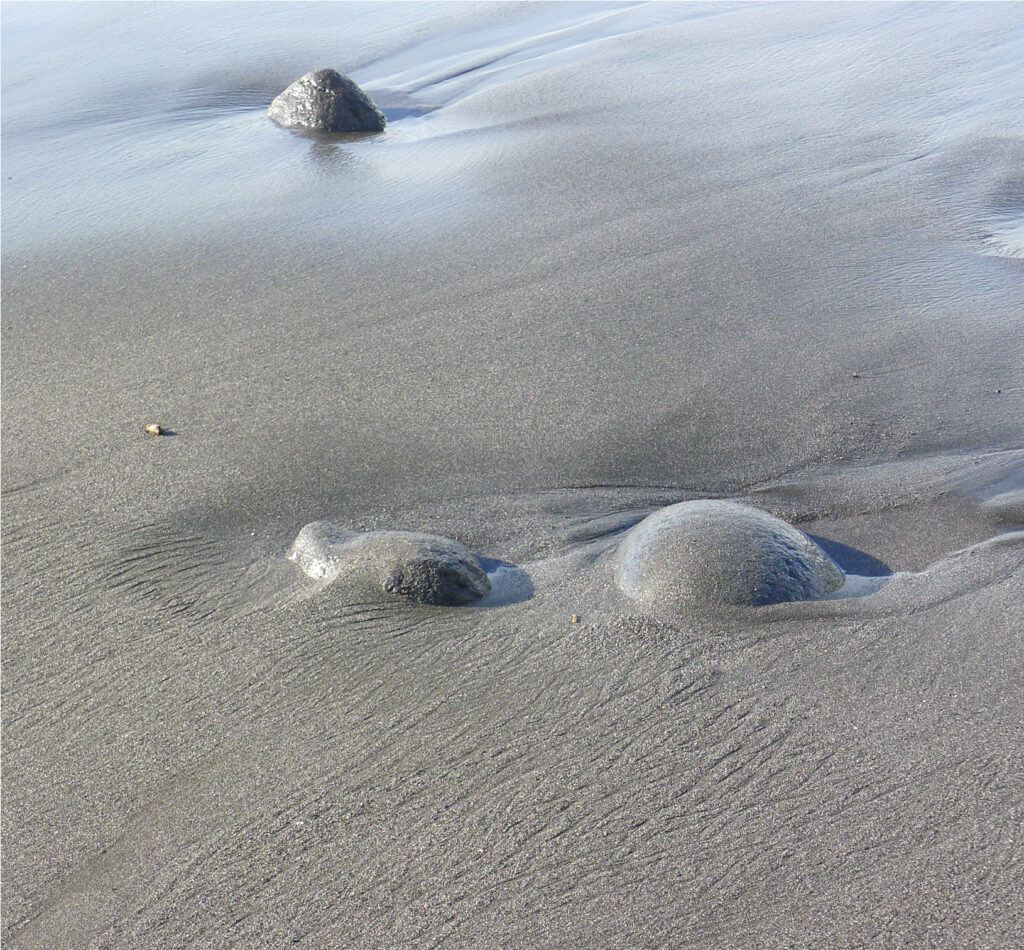
A gentle brush, it seems, has left its traces in the sand. A group of pebbles seek to hide into the shore. So sensual. Water has just caressed their surface — taking off a little at a time. Here they lie, half hidden, half exposed, resting gently in the sand.
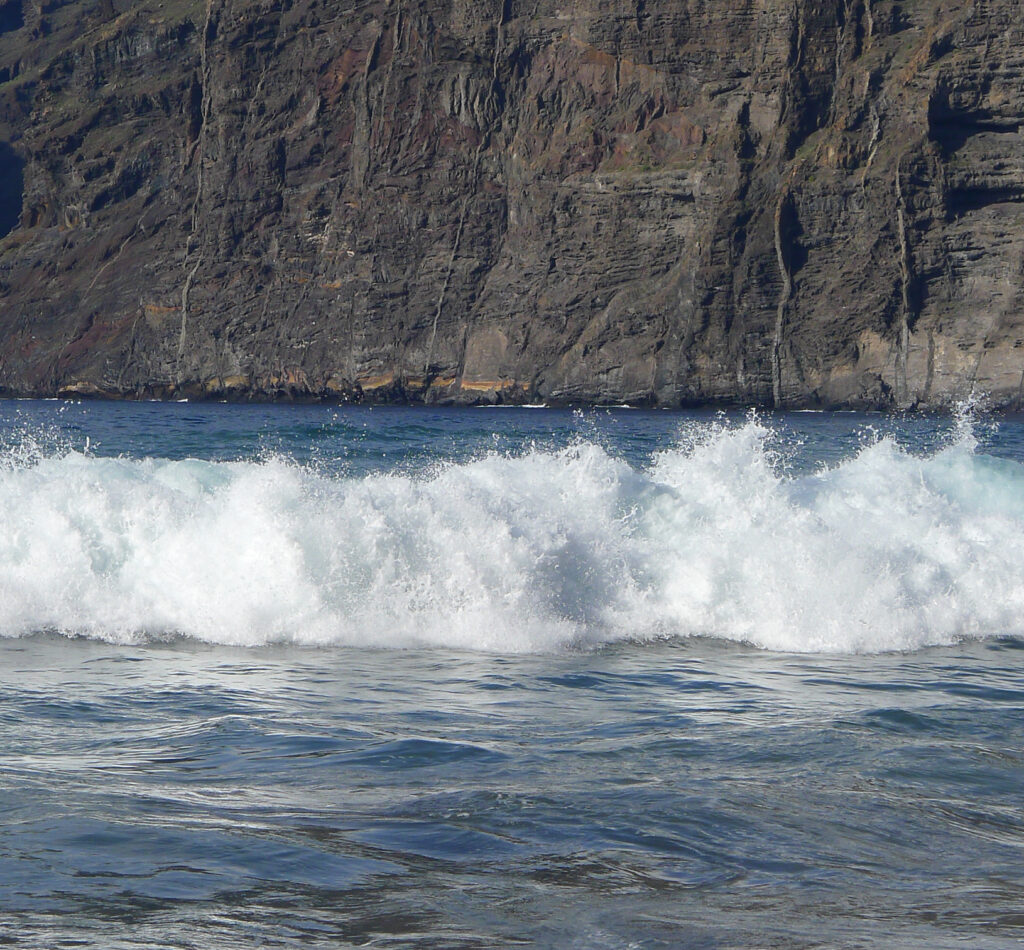
Breaking wave. Los Gigantes, Tenerife. Photo: Lasse Johansson
Whoosh. The water wave breaks joyously, cascading and foaming, noisily. The glassy towering ridge of water from the moment before is suddenly gone. Here releasing its power, all its thrust, in a joyous final motion before reaching the shore.
Sand-water rolls self-organizing in the receding stream. Agadir, Morocco. Photo: Lasse Johansson
Self-organizing, seemingly out of nothing, the sand-water rolls appear. Where did they come from? The moment before, when the incoming stream reached its highest level and turned, there was only a flat surface of murky water.
Self-organization means the spontaneous formation of a macroscopic structure, an order for free, as it were, emerging when the effects of the individuals, e.g. the movement of water molecules, start to interlock and add up, forming a new complexity. When the conditions are right, self-organization occurs, spontaneously, like a vortex forming in a bath tub.
Wild Duck (Mallard) swimming across a water surface, generating a wake behind it. Small waves can be seen capturing up with the main wake, overtaking it, and then dissolving as they advance ahead and loose their energy. Söderåsen National Park, Sweden. Photo: Lasse Johansson
Quietly, the duck swims across the water surface, its legs paddling silently underneath. Behind it, a small wake spreads distinctly, disturbing the otherwise completely still water surface. The sun is setting over the little lake – the oblique light causes the ripples to stand out, bringing them to my attention. Here at the outlet, just above a small dam, pieces of pond weed come drifting in an almost invisible current, and the duck hunts for food. Continue reading “The wake”
Water cascading down a flight of waterfall steps. Segment of Storåsfallet, Lärjedalen, outside Gothenburg, Sweden. Photo: Lasse Johansson
Breathtaking, the falling water rumbles down in front of me. At one place a metre or less, at another place cascading from so high above that I cannot estimate it. Moving with all its forms, and yet remaining firmly at the same place. Peaceful in all its turmoil.
What is it that makes it so majestic? Is it the murmuring splashing sound? Is it the slow motion movement, being pulled irresistibly towards the rim, and then falling, falling, falling, until the white foaming surface at the bottom comes to meet? Continue reading “The breath of water”
Water in the sky (clouds) reflecting the power from the sun that feeds us all. Sunset at Fredensborg, Sweden. Photo: Lasse Johansson
“It is junk science”, their adversaries would say. And with a decision ruled beforehand, there was really no need to examine all the intricacies in detail. The electrochemists Martin Fleischmann (1927-2012) and Stanley Pons (1943-) had, in a long series of experiments, observed heat production from electrolysis of heavy water with a special electrode made of palladium. The energy released far exceeded the electrical energy that was put into the experiment. Having examined possible sources of the energy, they had come to the conclusion that a nuclear reaction was going on, and the effect was dubbed “cold fusion” – an effect promising clean and unlimited energy from water. Continue reading “The power of water”
Reflections in an undulating water surface, stretching in the vertical direction. Slussen, Orust island, at the west coast of Sweden. Photos and illustrations: Lasse Johansson
Like a painting, the water surface shimmers. Its low undulating forms, just slightly curved, one in front of another, has been shaped by the wind or a passing boat, and the water surface comes to life. Like the memory filtering an artist’s impression, the water surface has its own way of filtering our impressions, the image of the land reflected across the bay appears fuzzy and smeared out. Continue reading “The artist’s water”