The natural flowform

Natural flowforms in the river Sjoa
Natural flowforms in a small side stream beside the main current of river Sjoa. Over time, water has carved the rounded forms, aided by the occasional boulder. Here they express a rhythm of their own, with water dancing from pond to pond. Sjoa, Norway. Photo: Dag Birkeland

Powerful, the mass of water is rushing past me, a white blueish foaming torrent. Confined between the towering stone walls in the gorge, the river here has acquired a relentless quality, thrusting forward unstoppable.

Making sure that I stand on firm ground, I observe it. Falling into the deep river here, one would be lost, immediately being taken into the depths by the strong fraying currents. Here a man’s power matters little. Continue reading “The natural flowform”

Water and climate

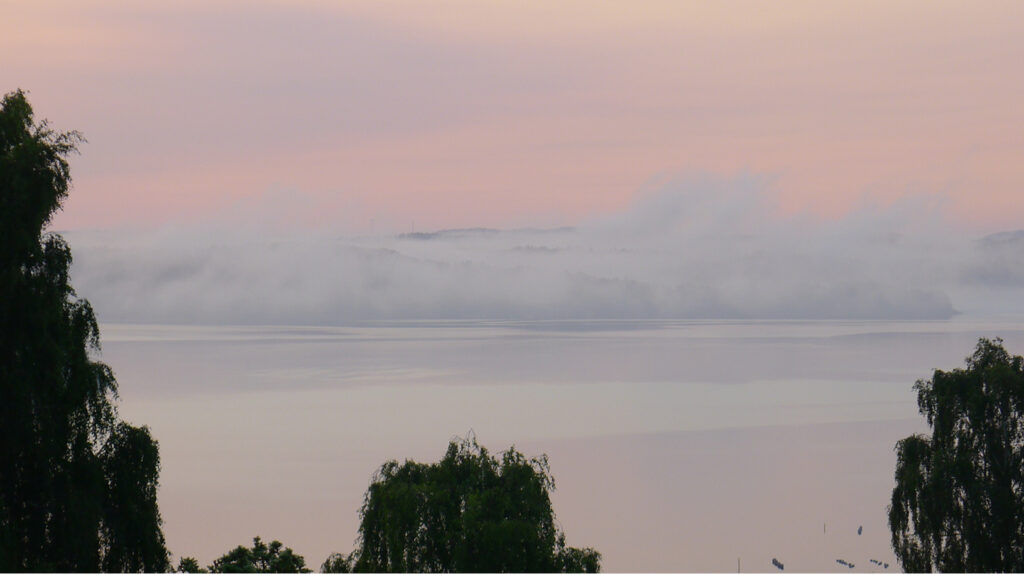
Clouds drifting off the coast at dawn
Clouds drifting off the coast at dawn. View from Orust island, at the west coast of Sweden. Photo: Lasse Johansson

Surrounded by mist, the tree covered ridges sleep across the water. Almost completely wrapped in clouds, the coast is waiting for the day to come. Slowly, slowly, the sun rises in the north-east, tinting the low-hanging clouds pink. Pale and yellow, gazing through the haze, it rises, starting to heat up the air, its heat being almost indiscernible. Continue reading “Water and climate”

When water freezes

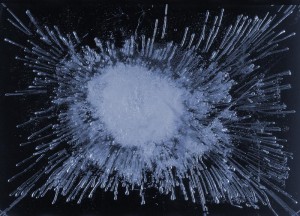
Distilled water ice image
Ice image of distilled water: A sparse and ordered structure surrounds the core. Photo: From the Gisela Ahlberg collection, Institute of Ecological Technology. (The photos have been slightly colorized.)

The temperature drops, water cools, and suddenly, there is a crest of ice on the surface, slowly growing and deepening. Soon it will be so hard that we can touch it without destroying it, and even walk on it. Anyone who has been skating on a lake will know that there is ice and there is ice. Sometimes clear, sometimes so filled with air bubbles as to be almost completely opaque.

The Swedish water investigator Gisela Ahlberg decided to explore this, and devised a method, together with her colleague Christina Weldero, to study natural waters by ice images. Continue reading “When water freezes”

Flow shaping with water plants

Stream water-crowfoot
Egg-shaped patch of Stream Water-crowfoot Ranunculus penicillatus in the Biała Lądecka stream, a submountainous river in Sudety Mountains, distr. Kłodzko, Poland. Photo: Wojciech Puchalski.

The Austrian forester and natural philosopher Viktor Schauberger (1885-1958) perceived many ways of altering a river’s flow, not by trying to steer water into a particular course, but by creating conditions for water to self-organize into a new flow pattern.

By altering the conditions, the river’s flow would effortlessly change into a new pattern. The flow would have a new structurally stable attractor, ever changing yet recognizable as the same. Continue reading “Flow shaping with water plants”

The quality of water

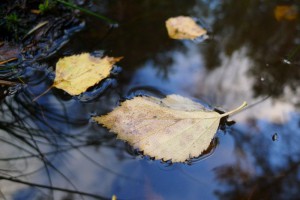
Leaves resting on amber-coloured pond
Birch tree leaves resting on the surface of a small amber-coloured pond that has formed after the rain. Photo: Lasse Johansson

In the autumn, leaves fall onto the ground, into the small ponds forming here and there, soon with brownish amber-coloured water. Resting for a moment on the surface, until a splash or a footstep causes it to cross the surface and sink towards the bottom, contributing to the forming colour.

As the leaves break down, the oxygen in the water is consumed, and the humus acids tint the pond. The water in the lower layers becomes reductive, oxygen deficit. Slowly the water sinks down, and enters the groundwater cycle.

What could these two things, the resting leaf and the amber-coloured water tell us about water quality? Continue reading “The quality of water”

Water’s pulse

“Malmö” model flowforms in Warmonderhof
“Malmö” model flowforms in Warmonderhof, the Netherlands. Photo: Hans van Sluis

Swish, swoosh, swish, swoosh, in a rhythmic pattern, the water swings to and fro in the vessel, a “flowform”, originally conceived by the British anthroposophist John Wilkes (1930-2011) in 1970 and since then developed into many shapes.

The incoming water flow, and the curved heart-shaped walls create the right conditions for a rhythmic flow to spontaneously emerge, to self-organize – a cooperative behaviour, which springs out naturally, effortlessly, from the conditions. The water molecules dance together. From vessel to vessel the dance continues, until the water reaches the pond below. Standing by the stair of flowforms, listening to the pulsating sound, it is as if it radiates tranquillity – a wild brook carved in stone. Continue reading “Water’s pulse”

The rising seas

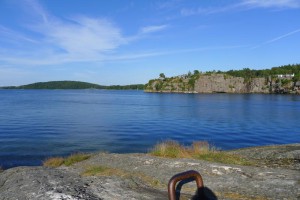
The dramatic coastline of Slussen
The dramatic coastline of the isles seems to rise just out of the sea. Slussen, Orust island, at the west coast of Sweden. Photo: Lasse Johansson

Slowly, almost imperceptibly, the water level rises. Where are we actually heading? What is the attractor of our present course? Where will we be, when water finds its new level?

Our actions are like a small marble, rolling down a slope, along a ridge, on its way to a new state. Will it be a state where the Arctic ice has melted, where its albedo, its ability to reflect light, has changed from that of white ice to dark water, no longer reflecting most of the light back into the sky? Will it be a state where the methane deposits of the Siberian tundra have molten and evaporated? Where the ice of Greenland has melted? Continue reading “The rising seas”

The water jet dances

The dancing water jet
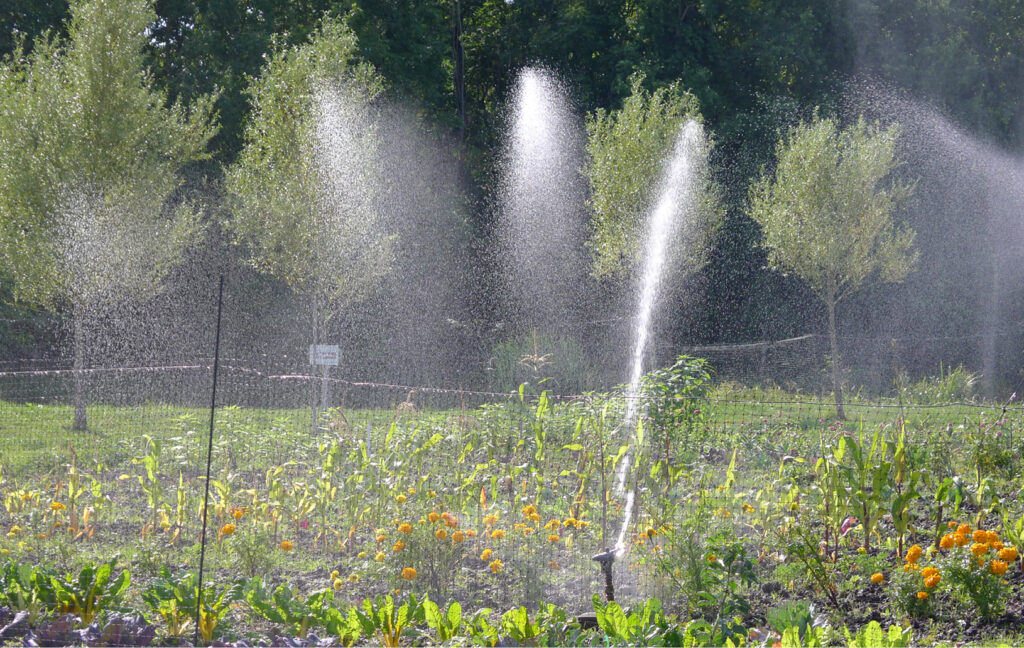
As the up-going flow bumps into the down-going, it starts to twist and bend. Botanical garden, Gothenburg, Sweden. Photo(s): Lasse Johansson

The jet of water ejects out of the nozzle in a continuous, steady flow. Directing my eyes towards the opening, there is not a trace of pulsation.

Yet just slightly above, the dance has begun. As the upward movement is gradually lost, the water jet starts to twist and bend, like a rubber band being pushed.

Then it turns around and sweeps down, now on this side, now on that, now hitting the up going flow and, for a moment, almost extinguishing it, and then it moves on again, unpredictable. Never at rest, oscillating, yet not repeating itself – its aperiodic undulations never reveal what is next to come. Continue reading “The water jet dances”

The water vortex

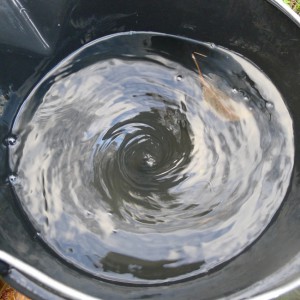
Water vortex in bucket
Water swirling in a bucket, with reflections of the sky in the water surface. A leaf is going with the flow.
Photo: Lasse Johansson

Round and round, the vortex swirls in the bucket, mixing whatever is in it. Perhaps one of our most mundane acquaintances with water is stirring it, although we seldom give the process a closer look. Stirring vigorously will only create a blur. But the moment we leave water on its own for a while, the curved spiralling shapes appear and stabilize. The vortex funnel has chosen its preferred form.

Does water mind how we stir it? Will it behave differently afterwards depending on our movements? Looking at water merely as a dead substance, we tend to relegate such questions to the fairy tales. But even a fairy tale can turn out to be true. And in this case – just as a good fairytale should – it is about a land down under. Continue reading “The water vortex”

Floating timber in brooks

The Taschbach stream in the Freinbach area
Part of the Taschlbach stream as it looks today, in the Freinbach area, Steiermark, Austria. Photo: Olof Alexandersson

“The logs will not float even 50 meters”, was the official position of the Austrian timber commission. The experts had even brought a signed written testimony to the futility of the project. It was a timber floating system, conceived by the forester Viktor Schauberger, who was presently being employed as a timber transport consultant by the Austrian Government.

The first section of the system had recently been completed in the Taschlbach stream, a wild and unruly river, not much larger than a brook. Continue reading “Floating timber in brooks”

Water and consciouness

Curved space - vortex funnel and ripples
“Curved space”, 1991. Ripples and funnel forming in a very gentle vortex flow in a large egg-shaped container.
Photo & design: Dag Birkeland

As if they were carved out, the ripples in the water hover before my eyes. The gentle vortex flow pulls the water down, only to return it to the surface again, following the walls of the egg-shaped container. Round and round, the water seems to form a complete universe of its own. It is unavoidable to be affected by the stillness.

Clearly, water can affect our thoughts. But can our thoughts affect water? Could, for example, our consciousness change a property or structure in a water sample? And could such a change in water be observed? This the Russian scientists Lev Pyatnitsky and V. Fonkin asked themselves. Continue reading “Water and consciouness”